Skip to Content

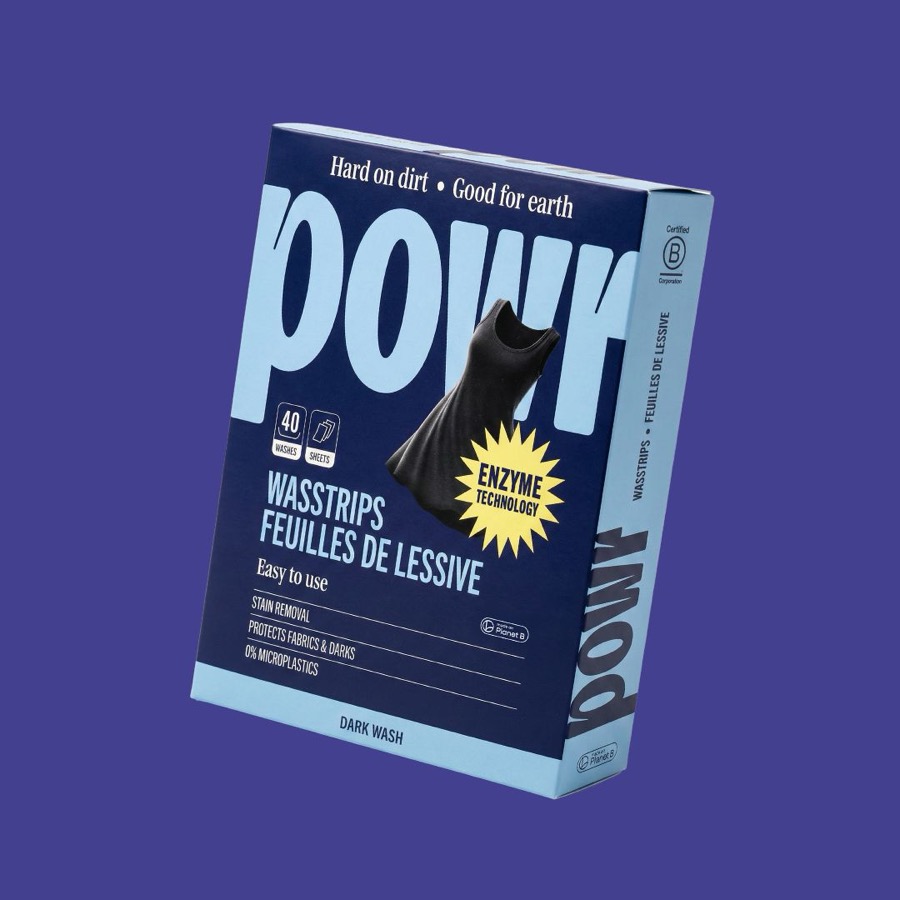
POWR Laundry Strips for dark wash

(0 review)

What makes our laundry strips so POWRful?

Our laundry strips are based on powerful enzyme formulas. The packaging is fully recyclable and free from harmful substances. Only POWR!

Thanks to advanced enzyme technology, stubborn stains, fats, proteins and odour-causing residues are broken down in a targeted way. The enzymes get to work during the wash, delivering a powerful, deep clean — even at lower temperatures!

  • 100% recyclable cardboard packaging – FSC-certified
  • With enzyme technology
  • Without microplastics
  • Biodegradable
  • Vegan
  • European production
  • Protects fabrics & colours
  • Stain removal

Important to know

  • Dissolves from 15°C
  • Suitable for all fabric types
  • Powerfully clean, preserves deep colours
Your positive IMPACT with this product
Every purchase counts double. At least 10% of your purchase amount goes straight to the charity of your choice — and you make a measurable difference to these UN Sustainable Development Goals (SDGs).
Plastic reduction
Plastic reduction
23,00 g
( for 40 washes )
more info
Plastic reduction
SDG 12 · Responsible consumption and production
Plastic reduction · 23,00 g
How we calculate this

1. The avoided bottle. An empty plastic bottle for 40 washes weighs ~50 g. POWR comes in cardboard.

2. But not everyone buys liquid. Of all the detergent sold in Europe, 47% is liquid, 42% powder and 11% capsules. Powder comes in cardboard, and since Ariel and Persil took the plastic scoop out of the box there is no plastic in it. So only that 47% actually replaces a bottle.

3. Weighted. 50 g x 47% = 23.5 g per 40 washes, conservatively rounded to 23 g.

Estimate: for capsules we do not know the plastic in their tub, so we count them as zero. And if a scoop is in a powder box after all, it does not count either. Both choices make our figure smaller, never bigger.

Source

Comparison with a conventional liquid detergent in a plastic (HDPE) bottle. An empty bottle for about 40 washes weighs ~50 g; POWR uses recyclable FSC cardboard (~0 g plastic). Verifiable yourself by weighing an empty detergent bottle.

The 47% liquid / 42% powder / 11% capsules split. From the market figures the European Commission research centre (JRC) used for the EU Ecolabel revision, based on Euromonitor via the detergent federation A.I.S.E.: liquid EUR 4.05 billion, powder EUR 3.55 billion, capsules EUR 0.95 billion. We deliberately leave fabric softener and laundry aids out of that count — POWR is pure detergent, so we compare only with detergent.

JRC: laundry detergent market figures, EU Ecolabel revision

Estimate: those figures are from 2012 and by sales value, not by number of washes. Liquid has been gaining on powder since: with more recent figures our number would come out higher, not lower. We stay on 2012 because it makes our own claim smaller. Belgium is not broken out; the powder share varies sharply by country (Poland 92%, Italy 27%).

The scoop. Ariel and Persil took the plastic scoop out of their powder boxes to save plastic; you order one free from their site. So we count powder as zero plastic.

Ariel: order your free dosing device

Laundry detergent bottle specifications (HDPE)

Why this matters

Plastic does not disappear. It breaks into ever smaller pieces and stays in our soil, rivers and sea for centuries. Every piece of packaging that is never made is the only plastic guaranteed never to wash up anywhere.

Concretely: this box replaces one whole plastic detergent bottle that never has to be made, filled, shipped or thrown away. And you can check it yourself: just weigh an empty detergent bottle.

This comparison is only here to make the number tangible. It is an illustration, not hard science.

By choosing an IMPACT product you avoid all of this. That does society, today and tomorrow, an enormous service and makes a big positive difference to the future of us all.
Microplastics reduction
1,80 g
( for 40 washes )
more info
Microplastics reduction
SDG 14 · Life below water
Microplastics reduction · 1,80 g
How we calculate this

1. Where they sit. Liquid detergent often contains non-degradable polymers that make it opaque. Per 40 washes that is ~4 g. Powder does not need them.

2. Weighted. Only the 47% liquid counts: 4 g x 47% = 1.88 g, rounded to 1.8 g per box.

Estimate: those 4 g are our own conservative estimate; we are asking POWR for the exact percentage. Capsules are not counted, which makes our figure smaller.

Source

Many liquid detergents contain non-degradable synthetic opacifying polymers; POWR is biodegradable and microplastic-free. Note: this is a conservative estimate - we are confirming the exact percentage with POWR.

The 47% liquid / 42% powder / 11% capsules split. From the market figures the European Commission research centre (JRC) used for the EU Ecolabel revision, based on Euromonitor via the detergent federation A.I.S.E.: liquid EUR 4.05 billion, powder EUR 3.55 billion, capsules EUR 0.95 billion. We deliberately leave fabric softener and laundry aids out of that count — POWR is pure detergent, so we compare only with detergent.

JRC: laundry detergent market figures, EU Ecolabel revision

Estimate: those figures are from 2012 and by sales value, not by number of washes. Liquid has been gaining on powder since: with more recent figures our number would come out higher, not lower. We stay on 2012 because it makes our own claim smaller. Belgium is not broken out; the powder share varies sharply by country (Poland 92%, Italy 27%).

The scoop. Ariel and Persil took the plastic scoop out of their powder boxes to save plastic; you order one free from their site. So we count powder as zero plastic.

Ariel: order your free dosing device

US patent 11,718,816 (opacifying polymers in detergents)

Why this matters

Microplastics are too small to filter back out of water. Whatever goes in, stays in: it is taken up by plankton and fish and comes back onto our own plates. A few grams sounds small, but this is waste that never leaves - the only real solution is never putting it there.

This comparison is only here to make the number tangible. It is an illustration, not hard science.

By choosing an IMPACT product you avoid all of this. That does society, today and tomorrow, an enormous service and makes a big positive difference to the future of us all.

CO2 reduction
CO2 reduction
68,00 g
( for 40 washes )
more info
CO2 reduction
SDG 13 · Climate action
CO2 reduction · 68,00 g
How we calculate this

1. The avoided bottle. ~50 g HDPE x ~2.9 kg CO per kg = 0.145 kg CO per 40 washes.

2. Weighted. Only the 47% liquid has such a bottle. Powder comes in cardboard, just like POWR — nothing to avoid there. 0.145 x 47% = 0.068 kg per box.

The avoided transport of water weight is not even counted.

Source

Liquid detergent is mostly water (40-90%) in a plastic bottle - heavy to make and to ship. Producing HDPE plastic costs about 2.9 kg CO₂ per kg (peer-reviewed). The bottle weight (~50 g for 40 washes) comes from the same source as above.

The 47% liquid / 42% powder / 11% capsules split. From the market figures the European Commission research centre (JRC) used for the EU Ecolabel revision, based on Euromonitor via the detergent federation A.I.S.E.: liquid EUR 4.05 billion, powder EUR 3.55 billion, capsules EUR 0.95 billion. We deliberately leave fabric softener and laundry aids out of that count — POWR is pure detergent, so we compare only with detergent.

JRC: laundry detergent market figures, EU Ecolabel revision

Estimate: those figures are from 2012 and by sales value, not by number of washes. Liquid has been gaining on powder since: with more recent figures our number would come out higher, not lower. We stay on 2012 because it makes our own claim smaller. Belgium is not broken out; the powder share varies sharply by country (Poland 92%, Italy 27%).

The scoop. Ariel and Persil took the plastic scoop out of their powder boxes to save plastic; you order one free from their site. So we count powder as zero plastic.

Ariel: order your free dosing device

Peer-reviewed review of CO2 emissions from plastic production

Conversion to km: we use 0,097 kg CO2 per km. That is the official average for new passenger cars in the EU, Norway and Iceland (96.7 g/km in 2025, provisional figure from the European Environment Agency) - the same value used on your invoice. EEA

Why this matters

CO is invisible, which is exactly why it is so easy to ignore. So make it visible: the 68,00 g of CO you avoid with this product is roughly 1 km you did not drive.

This comparison is only here to make the number tangible. It is an illustration, not hard science.

By choosing an IMPACT product you avoid all of this. That does society, today and tomorrow, an enormous service and makes a big positive difference to the future of us all.

Possibly available soon

Currently in talks with POWR.